
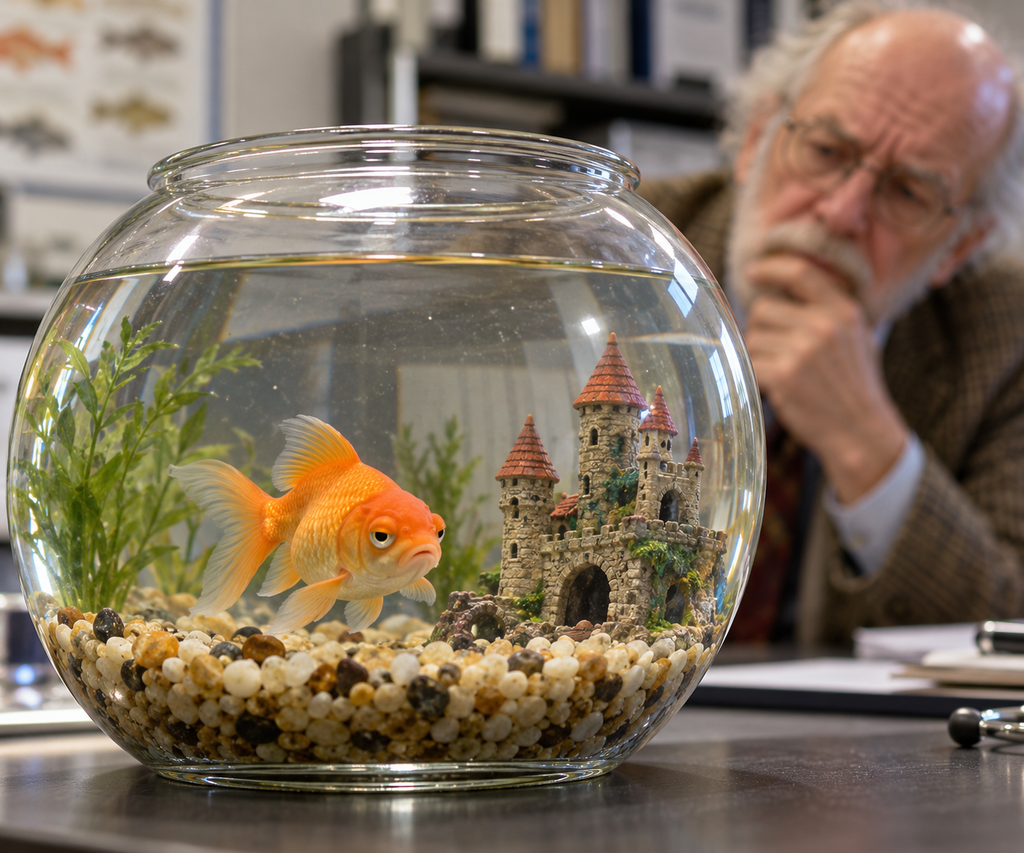
Patient: Bubbles
Species: Carassius Auratus (Domestic Goldfish)
Age: 11 years
Sex: Female
Owner: Mrs Penelope Pemberton-Smythe, Mosman, NSW
Attending Specialist: Honorary Emeritus Professor Geoffrey Whitmore, PhD, Department of Marine Biology, College of Science and Engineering, James Cook University, Townsville, Qld, Australia
Patient History
Bubbles, an eleven-year-old female goldfish, was referred to MenoPaws Veterinary Hospital following concerns regarding progressive memory impairment, disorientation and possible age-related cognitive decline.
Her owner, Mrs Penelope Pemberton-Smythe, a 76-year-old retired school principal residing in Mosman, Sydney, reported increasingly troubling changes in Bubbles’ behaviour over the preceding eighteen months.
According to Mrs Pemberton-Smythe, Bubbles had begun exhibiting repetitive swimming patterns, frequently revisiting sections of her aquarium that she had occupied only moments earlier.
Of particular concern was Bubbles’ apparent inability to remember the location of a decorative ceramic castle, despite having lived alongside it for more than a decade.
Mrs Pemberton-Smythe also reported that Bubbles had become increasingly unresponsive to verbal instructions and frequently appeared not to recognise her name.
“I’ve had Bubbles for eleven years,” Mrs Pemberton-Smythe explained. “She used to be such an intelligent little thing. Now she just swims around in circles, as though she doesn’t remember where she’s been.”
Bubbles was initially examined by MenoPaws’ in-house marine veterinary specialists, who conducted a series of preliminary neurological and behavioural assessments. Despite extensive investigations, the clinical team was unable to establish the underlying cause of Bubbles’ suspected cognitive decline.
Given the complexity of the case and Mrs Pemberton-Smythe’s comprehensive pet insurance policy, which covered specialist consultations, diagnostic investigations and travel expenses, the team sought the expertise of Honorary Emeritus Professor Geoffrey Whitmore, PhD.
Formerly associated with the Department of Marine Biology at James Cook University, Professor Whitmore has 37 years of experience investigating neurological and psychological disorders in ageing aquatic animals.
MenoPaws arranged for him to be flown business class from Townsville to Sydney, with all associated expenses charged to Mrs Pemberton-Smythe’s insurance policy.
Professor Whitmore agreed to undertake a comprehensive neuropsychological assessment of Bubbles, describing the referral as an intriguing opportunity to investigate the poorly understood relationship between memory, ageing and psychological wellbeing in domestic goldfish.
While staying at the Ritz-Carlton Hotel in Sydney, Professor Whitmore spent four weeks conducting an extensive battery of neurological, behavioural and psychological tests on Bubbles, revealing several intriguing findings.
Initial investigations focused on Bubbles’ short-term memory retention, spatial awareness and capacity for associative learning. Using a specially designed Piscine Cognitive Assessment Battery (PCAB), Professor Whitmore evaluated her ability to recognise familiar objects, anticipate feeding times and navigate previously encountered environments.
Contrary to Mrs Pemberton-Smythe’s concerns, Bubbles demonstrated remarkably well-preserved cognitive function.
During controlled spatial recognition trials, Bubbles successfully located a familiar ceramic castle on 97.3% of occasions, even when the ornament had been repositioned within the aquarium. Professor Whitmore interpreted this as evidence of advanced environmental object permanence, a phenomenon rarely documented in geriatric goldfish.
Further investigations employing the Whitmore Aquatic Memory Retention Index (WAMRI) demonstrated that Bubbles could reliably anticipate feeding times and distinguish between familiar and unfamiliar aquarium decorations. Her performance placed her in the 94th percentile for age-adjusted piscine cognitive function.
Particularly noteworthy was Bubbles’ performance during the Repetitive Circumnavigation Assessment, in which she completed 47 consecutive circuits of her aquarium without any measurable deterioration in swimming accuracy or navigational efficiency.
Although Mrs Pemberton-Smythe had previously interpreted this behaviour as evidence of profound disorientation, Professor Whitmore suggested that it might instead represent a sophisticated form of self-directed environmental reinforcement, possibly associated with advanced cognitive processing.
A subsequent series of tests examined Bubbles’ capacity for social recognition and emotional responsiveness.
Despite repeated attempts to establish verbal communication, Bubbles remained entirely unresponsive to Professor Whitmore’s questions. This included a structured 90-minute clinical interview during which she failed to answer any of the 83 questions presented.
Professor Whitmore noted that such behaviour could indicate Selective Interspecies Communicative Withdrawal Syndrome (SICWS), although he acknowledged that the diagnostic criteria for this condition remained poorly established.
Perhaps the most significant finding emerged during the final week of testing, when Bubbles demonstrated an unexpected ability to recall the location of food introduced into her aquarium several days earlier.
This result directly contradicted the widely held assumption that goldfish possess a memory span of approximately three seconds.
Professor Whitmore described the finding as “potentially transformative for our understanding of geriatric piscine neuropsychology.”
However, he cautioned that Bubbles’ apparent cognitive competence should not be interpreted as definitive evidence of psychological wellbeing.
“The absence of demonstrable memory impairment,” Professor Whitmore concluded, “does not necessarily indicate the absence of a memory-related psychological disorder.”
Consequently, despite finding no objective evidence of cognitive decline, Professor Whitmore recommended a further programme of intensive psychological assessment to investigate the possibility that Bubbles was experiencing anxiety associated with the perception that her memory was deteriorating.
Treatment and Management
As a result of Professor Whitmore’s findings, the clinical team at MenoPaws referred Bubbles to Dr Eleanor Harcourt, PhD, a highly regarded aquatic psychologist specialising in the treatment of emotional and behavioural disorders in ageing fish.
Dr Harcourt recommended a 30-week programme of intensive psychotherapy, incorporating individual counselling sessions, cognitive reassurance therapy and structured interventions designed to address Bubbles’ suspected anxiety regarding her own memory.
The principal therapeutic objective was to restore Bubbles’ confidence in her cognitive abilities, despite the absence of any measurable memory impairment.
Dr Harcourt emphasised that the successful treatment of piscine psychological disorders requires considerable patience, particularly when patients demonstrate a persistent unwillingness to participate in verbal psychotherapy.
Clinical Outcomes
As Bubbles remains in the early stages of her 30-week psychotherapy programme, it is not yet possible to determine whether her perceived anxiety concerning her memory is beginning to subside.
Dr Harcourt has reported some encouraging signs of emotional improvement, although Bubbles continues to demonstrate a marked reluctance to discuss her feelings. Should her progress remain limited, the clinical team may consider introducing venlafaxine as an adjunct to her ongoing psychotherapy, subject to further specialist assessment.
MenoPaws Veterinary Hospital wishes to acknowledge the generous support of FurSure Platinum Pet Insurance, whose comprehensive coverage has made Bubbles’ extensive diagnostic investigations and ongoing psychological treatment possible.
Unfortunately, following a recent review of our clinical practices and insurance claims, FurSure has advised that MenoPaws Veterinary Hospital is no longer authorised to treat animals insured under its scheme.
Diagnostic Report
Download the full diagnostic report on this case.
Leave a Reply